Hello, and happy Monday.
First a quote: “If you don’t like change, you’re going to like irrelevance even less.” — General Eric Shinseki
Over the years, I’ve often written and spoken about the topic of change and change leadership. I became interested in this topic after experiencing four major corporate merger/acquisitions personally.
It was painful to watch many of my friends and colleagues go through these transitions, often magnifying and exaggerating the possible negative outcomes.
And yet, if I’m honest, I still catch myself doing the very thing I coach others not to do.
When something new appears on the horizon, my mind doesn’t immediately rush to positivity and possibility. Instead, it often drifts toward risk, fear, and a seemingly endless list of possible negative outcomes.
It is amazing how creative our minds can become when faced with change and all the things that may go wrong. One of my favorite quotes:
“Worry is a misuse of our imaginations” – Dan Zadra
We’re seeing the same thing now with Artificial Intelligence.
When A.I. tools first began accelerating into the mainstream, the headlines began to shout, and will likely continue to shout:
-
Jobs will disappear.
-
Entire industries will be disrupted.
-
Human creativity will be replaced.
I see these possible negative outcomes as very real possibilities. In many industries, those things are already happening. It is easy, and frankly, understandable, to step back and focus on what might be lost.
The question becomes, is there a healthier approach?
Why is it our first reaction is typically to seek, and feed, the possible negative outcomes? Why is that our first focus?
As I have begun to lean-in and experiment with A.I. in my own realm of responsibilities, the narrative has begun to shift a bit for me. I’m also beginning to see the immense range of possible positives that lie ahead.
Instead of replacing thinking, A.I. may sharpen it.
Instead of eliminating creativity, A.I. may expand it.
Are there serious questions to be answered? Yes! Are there legitimate concerns? Of course.
Reflecting on these questions, as when going through major career changes, I was again reminded of our human tendencies.
“We tend to exaggerate possible negatives related to change. But to make matters worse, we also tend to minimize the probable positives.” - Bryan Yager
Sound familiar? What is your experience when facing significant change?
Why We Do This?
Our brains are hard-wired to protect us! Uncertainty feels unsafe; so, we instinctively scan for threats. Possibilities that are negative jump to the forefront of our minds and get our immediate attention and mental energy.
Probable positives get relegated to the back recesses of our minds.
And, if we rehearse the negative long enough, it begins to feel inevitable.
But possible, does not mean probable.
Our Leadership lenses.
As leaders, we set the emotional tone around change.
If we exaggerate risk, our teams will too.
If we ignore opportunity, they may miss it as well.
History gives us perspective on this topic. The printing press. Electricity. Automobiles. The personal computer. The internet. Smart Phones: each advancement disrupted something in ways we never imagined.
Each also unlocked something extraordinary.
A.I. will be no different.
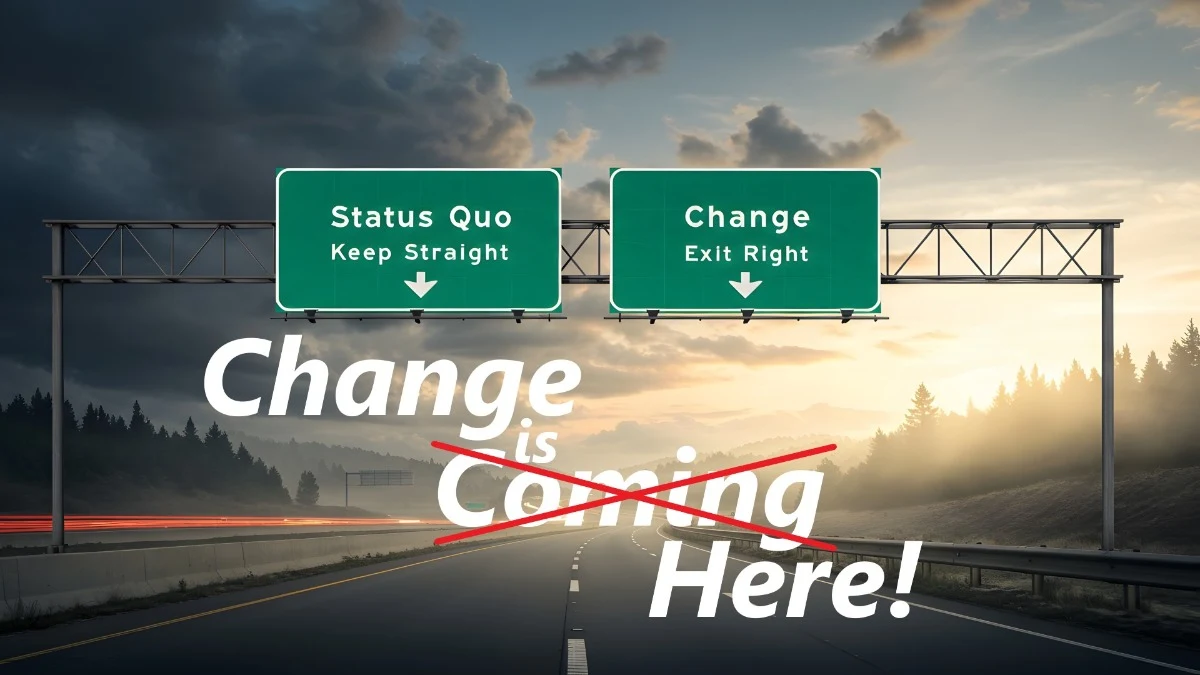
The question is not whether change is coming. The question is: How will we frame it?
Final Thought
When facing change, most of us instinctively ask, “What might I lose?”
Leadership asks an additional question: “What might we gain?”
When faced with big changes, if you feel yourself bracing for the worst, pause; name the risks, but also name the opportunities.
The future is rarely as catastrophic as we imagine and often more promising than we predict in our minds.
Related Articles & Resources:
Bonus Quotes Below.
How will you live, love, or lead, differently, or better, this week?
Sincerely,
Bryan Yager
“Expanding Your Capacity for Success”
PS
Many of the ideas shared in this MMM series, show up in my recently released book, “How to Transition into Leadership …and Why that Changes Everything.”
While the book focuses primarily on management and leadership, the lessons apply just as powerfully to our important relationships outside of work.
Save $5.00 off retail through the end of March.
What others are saying:
Overall, this is a thoughtful, encouraging resource that reframes leadership as a personal transformation rather than a job title. What resonated most with me is his emphasis that success as a leader is no longer about how much you personally accomplish, but about how well you enable others to succeed. This book is concise and full of insights you can use right away. I’m keeping this on my bookshelf as a valuable resource. Well Done!
Amazon Customer
Bonus Quotes:
-
“It is not the strongest of the species that survive, nor the most intelligent, but the one most responsive to change.” – Charles Darwin
-
“The greatest danger in times of turbulence is not the turbulence; it is to act with yesterday’s logic.” — Peter Drucker
-
“The measure of intelligence is the ability to change.” – Albert Einstein
-
“We cannot become what we want by remaining what we are.” – Max DePree
-
“When we are no longer able to change a situation, we are challenged to change ourselves.” – Viktor E. Frankl
-
“The only way to make sense out of change is to plunge into it, move with it, and join the dance.” – Alan Watts
-
“In a time of drastic change, it is the learners who inherit the future.” – Eric Hoffer
-
“Every act of creation is first an act of destruction.” – Pablo Picasso
Do you know someone who might benefit from this weekly leadership minute? If so, please feel free to pass along the subscription link below:
-
On LinkedIn: Click here to subscribe to the MMM newsletter on LinkedIn. (Recommended)
-
Via email: Click here to subscribe to MMM and have it sent directly to your email inbox each Monday.