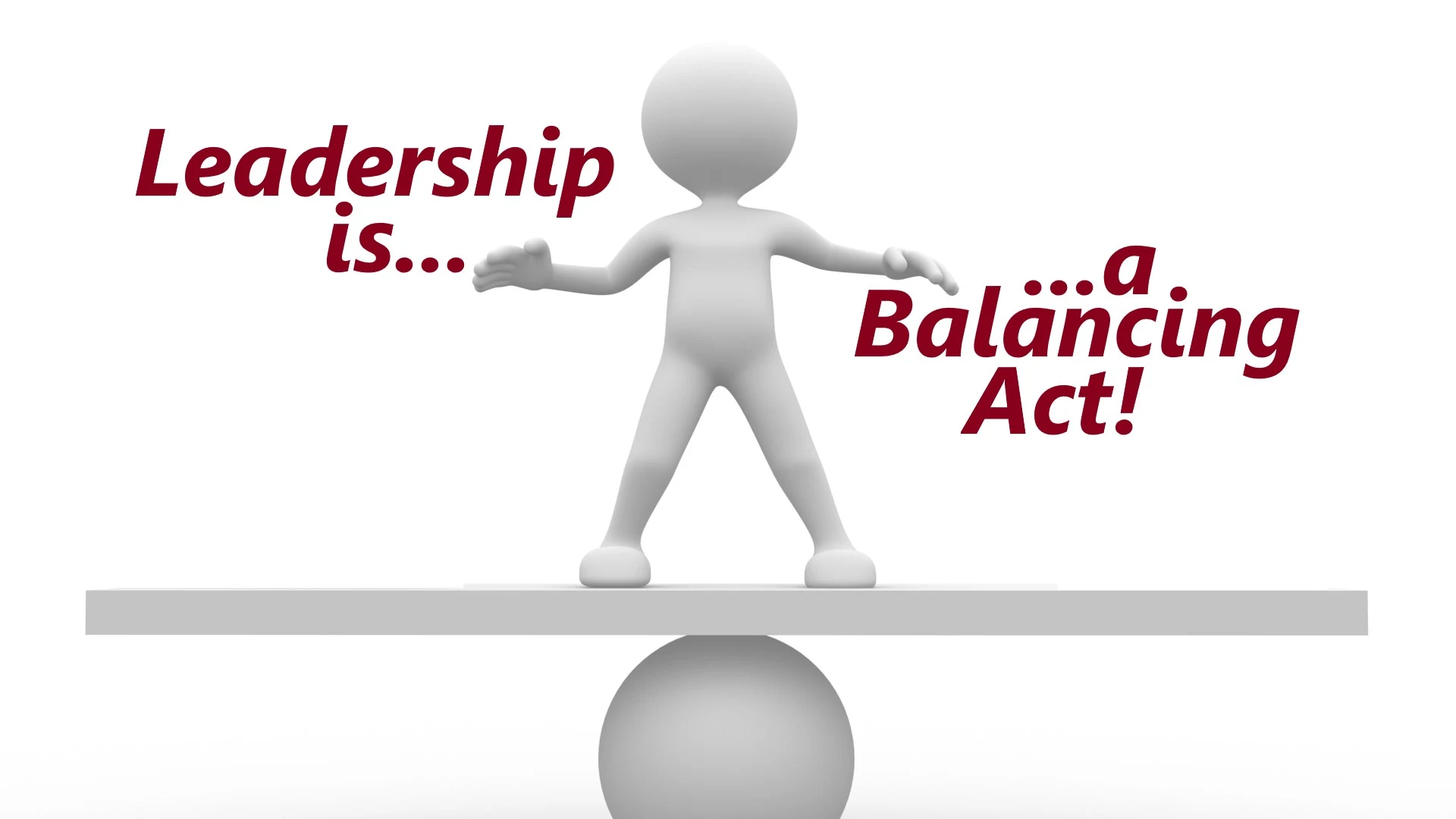
First a quote: “In the end, it’s all a question of balance.” – Rohinton Mistry
Hello and happy Monday.
I find the art of leadership to be fascinating for so many reasons.
One of those reasons is that leaders must often walk a fine line between seemingly opposing forces, contrasting priorities, and complex decisions. There are so many dichotomies involved in the realm of leadership.
Leadership truly is a balancing act!
For example, here are just four of the many opposing forces that leaders must face as they lead their organizations:
-
Know when to act with urgency and when to sit quietly and think.
-
Know when to speak boldly with authority and when to listen quietly with heart.
-
Project confidence without arrogance; to operate from a place of confident humbleness.
-
Exhibit transparency and vulnerability yet balanced with discernment and discretion.
My focus today is on yet another topic requiring balance, wisdom, and decision making.
When thinking about how rapidly our world is changing (think college football conference realignment, or of a more serious nature, artificial intelligence, American politics and our democracy, global warming, or world peace as examples) leaders must find themselves pondering two opposing questions:
What should be preserved?
What must be changed?
When faced with significant change, organizations often find themselves at a crossroads between preserving their core values and stimulating progress. The delicate balance between tradition and innovation can determine the long-term success of an organization.
The challenge lies in embracing change while staying true to the principles which have served as the foundation of your past success.
In his book, “Built to Last,” author Jim Collins described this concept as “Preserve the core while simultaneously stimulating progress.” Click here to read more about the Preserve the Core/Stimulate Progress concept.
Enduring organizations (countries and cultures) exhibit a dynamic duality. On the one hand, they have a set of timeless core values and purpose that remain constant over time.
On the other hand, they have a relentless drive for progress… change, improvement, innovation, and renewal.
Great organizations keep clear the difference between their core values (which never change), and operating strategies and cultural practices (which endlessly adapt to a changing world).
Preserving the core of an organization involves safeguarding its foundational values, identity, and the essence that sets it apart from everyone else. This core is often rooted in the organization’s mission, vision, and the beliefs that underpin its operations.
Core values act as a moral compass, guiding decision-making, shaping company culture, and influencing how the organization interacts with its associates, customers, and stakeholders.
On the other hand, stimulating progress entails embracing innovation, adopting new technologies, and remaining adaptable to shifts in the market. As industries evolve and consumer expectations change, businesses must continuously find ways to stay relevant and meet the evolving demands of their customers.
Progress requires a willingness to disrupt existing norms, experiment with novel approaches, and explore uncharted territories.
Following are a few strategies for your consideration as you strive to balance these dichotomies in your world:
-
Long-Term Vision: Develop a long-term vision that encompasses both core preservation and progress. This vision can guide decision-making and provide a roadmap for navigating challenges.
-
Clear Core Value Communication : Ensure that your core values are well-defined and effectively communicated to associates, customers, and stakeholders. When everyone understands the fundamental principles guiding the business, it becomes easier to make decisions that align with those values.
-
Innovation with Purpose: Innovate with a clear purpose that is aligned with the core values. Whether it’s adopting sustainable practices or enhancing customer experience, innovations should reflect the underlying principles of the company.
-
Continuous Learning and Adaptation: Foster a culture of continuous learning and adaptation. Encourage employees to stay updated on industry trends, technological advancements, and market shifts. This knowledge can inform progressive strategies that align with the company’s values.
-
Customer-Centric Approach: Focus on understanding and addressing customer needs. As customer preferences change, adapting to those preferences while upholding core values demonstrates a commitment to both progress and preservation.
-
Balanced Risk-Taking: Taking calculated risks is essential for progress, but these risks should be evaluated against core values. This ensures that the pursuit of growth doesn’t compromise the ethical and moral foundations of the business.
Preserving the core while stimulating progress is not a linear journey; it’s an intricate dance that requires ongoing adaptation and mindfulness. Striking the right balance can prevent the erosion of identity due to rapid change and guard against stagnation that comes from clinging too tightly to the past.
The endeavor to preserve the core and stimulate progress reflects our resilience as humans, as organizations, or even as a country. It is a testament to our capacity to honor our roots while reaching for the stars.
As we navigate this intricate path, let us remember that the past informs our present, and our present shapes our future – a future where tradition and innovation must walk hand in hand, enriching each other along the way.
As always, might I suggest we each strive to be “our best selves” this coming week. Unless we each do our part individually, we cannot make this a better world collectively.
Everyone can make a difference, and everyone should try!
How will you live, love, or lead, differently, or better, this coming week?
Regards,
Bryan Yager
“Expanding Your Capacity for Success”
Do you know someone who might benefit from this weekly leadership minute? If so, please feel free to pass along the subscription link below:
-
On LinkedIn: Click here to subscribe to the MMM newsletter on LinkedIn.(Recommended)
-
Via email: Click here to subscribe to MMM and have it sent directly to your email inbox each Monday. (Please note: I plan to discontinue this service later this fall. If you’re on LinkedIn, I recommend subscribing with link above.)
Bonus Quotes:
-
“In the end, it’s all a question of balance.” – Rohinton Mistry
-
“Change before you have to.” – Jack Welch
-
“People don’t resist change. They resist being changed!” – Peter Senge
-
“The world hates change, yet it is the only thing that has brought progress .” – Charles Kettering
-
“Life is about balance. Be kind, but don’t let people abuse you. Trust, but don’t be deceived. Be content, but never stop improving yourself.” – Zig Ziglar
-
“The greatest danger in times of turbulence is not the turbulence – it is to act with yesterday’s logic.” – Peter Drucker
-
“Your success in life isn’t based on your ability to simply change. It is based on your ability to change faster than your competition, customers, and business.” – Mark Sanborn
-
“Life is balance of holding on and letting go.” - Rumi
-
“Change is hard because people overestimate the value of what they have and underestimate the value of what they may gain by giving that up.” – Ralph Stayer
-
“Change is the law of life and those who look only to the past or present are certain to miss the future.” – John F. Kennedy