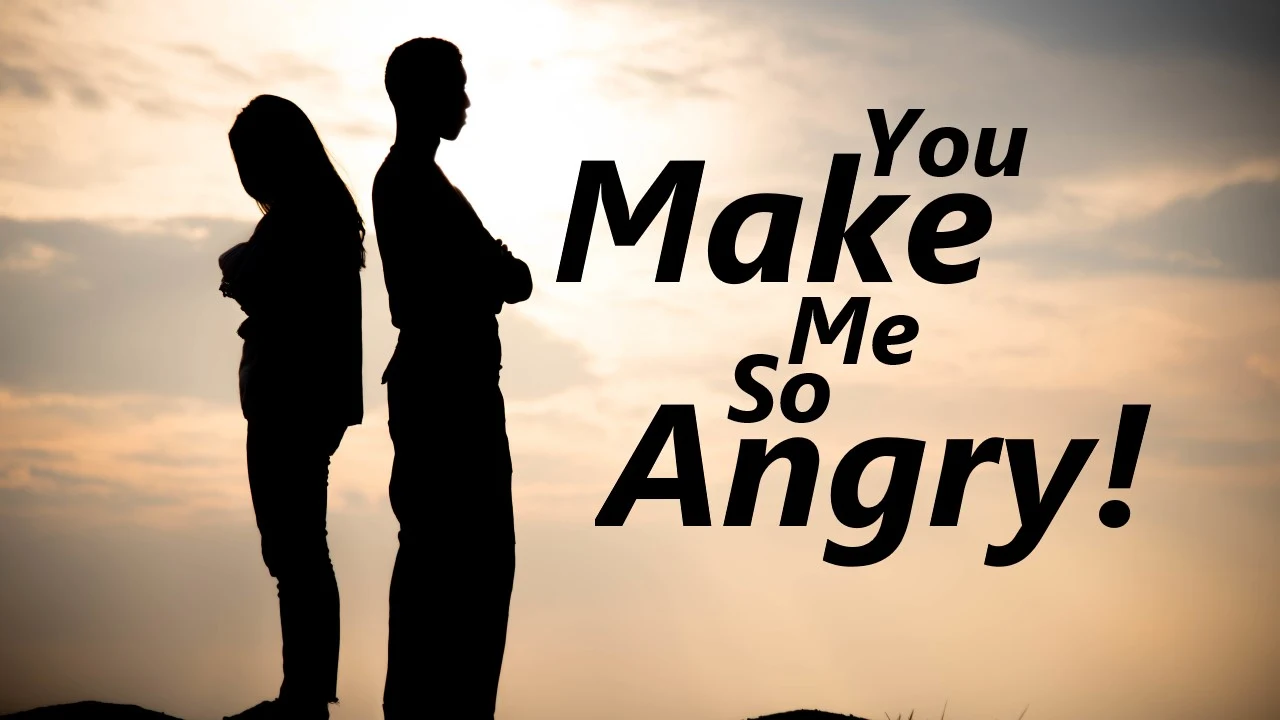
First a quote: “People can’t drive you crazy if you don’t give them the keys.” — Book title, authored by Mike Bechtle
Note: modified & updated; originally published on 4/8/2019
Let’s start with several questions for your thoughtful consideration:
-
“Is it possible to make another person angry?”
-
“Can we make another person feel any emotion… i.e., love, happiness, sadness, depression, or joyfulness? Or, how about making someone feel motivated at work?”
-
“Can we truly make another human being feel anything they don’t either allow, choose, or create for themselves?”
My experience, and research, suggest no one can make another person feel any emotion, at least not without that person’s complicity, cooperation, involvement, or without yielding to “victim mentality.”
Victim mentality is when we continually blame others for our situations and our reactions to them. Or, in this example, our emotions, for instance: “You make me so angry.” This statement implies the speaker has no personal accountability for their feelings, or perhaps more importantly, no responsibility for their actions because of the anger. It suggests their personal feelings are someone else’s responsibility.
And, who among us hasn’t said, thought, or heard someone else say the words, “You make me so angry?”
Are we willing to admit a 7-year-old child has the power to make grown, supposedly mature adults, angry enough to act out of control, to raise our voices, or even act like 7-year-olds ourselves?
When we’re thinking rationally, the answer is an easy, and resounding, absolutely not! Unfortunately, thinking and acting rationally, while emotionally charged, is not easy.
“Any person capable of angering you becomes your master.” – Epictetus
Five foundational thoughts for your consideration:
-
Emotions happen - emotions are normal and natural. We rarely choose, at least initially, the emotions we experience. When someone “cuts us off” in traffic and we feel anger, our spouse is “nit-picky”, and we feel irritation, we are faced with unexpected problems at work, and we feel stress. When our manager walks past us in the morning without saying hello, and we feel unimportant. When our parents use a “harsh tone” and we feel unloved. When our college student doesn’t call home and we feel lonely or unappreciated. All of the preceding examples can rightfully trigger emotions.
-
Emotions aren’t good or bad, they just are – we tend to judge emotions as either good or bad. For instance, love and happiness are “good emotions” and anger or jealously are “bad emotions.” Emotions, in and of themselves, are not good or bad, they just are.
-
Emotions make us human – we are emotional beings. As human beings, we are constantly balancing two, often opposing, forces: being logical or practical and being emotional. These two forces are often pulling in opposite directions. The force that wins most of the time, may very well determine how well we get along with others, and our level of success in life. This is the subject of many books now available regarding the topic of emotional intelligence. (I’ve included links below to my favorite books on the topic.)
-
Emotions provide richness in our lives – Love feels more meaningful when we have known loneliness. Victory feels sweeter when we have also known defeat. Success is more rewarding when we have overcome failures. Movies with happy endings are more moving if we cried or experienced sadness in the middle. You get the point, richness in life is greatest when we experience the full emotional tapestry of what it means to be fully human.
-
Emotions are not the problem – to be emotional is to be human. Problems arise when we act out of our emotions; when we allow our emotions to drive our actions without a conscious and deliberate “manual override button” to push. We must find ways to express and discuss, our emotions more productively and rationally. The following thought may seem obvious when we’re thinking rationally but: when we act out our emotions in a destructive manner, it is destructive to ourselves, to our relationships, and to others.
I’ll conclude with a short personal story. I so wish I could say I have always acted professionally at work. And, I also wish I could say I have always acted lovingly towards the most important people in my life… my friends, family, including parents, siblings, my spouse, and our two children. Of course, that is not the case.
Many years ago, when our children were young, something happened at home that “made me angry.” While I remember the event, I no longer remember the details, or what triggered my emotional reaction. (I suspect our children remember the details because they were the recipients of my anger… an outburst of emotions that I regret.
“If you are patient in one moment of anger, you will escape a hundred days of sorrow.” Chinese Proverb
A few days later, after the emotions of the event had passed, my wife Becky used the occasion as a “teaching moment.” As we discussed the situation, I explained how my anger wasn’t my fault and how my tone and raised voice couldn’t be helped. (Signs of the victim mentality described above.)
She listened patiently before asking, “Do you remember answering a business call in the middle of your angry outburst?” “Yes,” I responded, already sensing she had me cornered. She then followed with, “Bryan, what was your tone when you answered the phone?”
In a matter of less than two rings of my office phone, I went from an emotional ugliness with my children to a very professional, “Good afternoon, this is Bryan, how may I help you?” And, even more difficult for me to confess; I returned to my angry state at the conclusion of my professional call.
The truth is, I wanted to be angry because in that moment I felt justified in that anger.
The moral of this story is that I could, and did, control my anger when I needed to do so. I needed to sound professional for my client call. This means of course, I could have controlled my anger in the situation with my children as well.
I have never forgotten that lesson. I still slip up on occasion… because after all, I’m human, and humans are emotional beings. We all are.
In those moments where a situation, or person, has “made me angry,” I have found repeating the following affirmation to be helpful:
“I can’t help the way I feel right now, but I can control how I respond, and how I act if I want to.”
I hope repeating this affirmation might be helpful for you as well.
Let’s all learn from, appreciate, and enjoy our emotions; they are after all, the essence of our relationships and our lives. The goal isn’t to be emotionally perfect… simply better, in every way, every day.
Related articles:
Suggested reading:
Do you know someone who might benefit from this weekly leadership minute? If so, please feel free to pass along the subscription link below:
-
On LinkedIn: Click here to subscribe to the MMM newsletter on LinkedIn. (Recommended)
-
Via email: Click here to subscribe to MMM and have it sent directly to your email inbox each Monday. (Please note: I plan to discontinue this service on August 1, 2023. If you’re on LinkedIn, I recommend subscribing with link above.)
Have a good week!
And, as always, how will you live, love, or lead, differently, or better, this coming week?
Bryan Yager
“Expanding Your Capacity for Success”
Bonus Quotes:
· “For every minute you remain angry, you give up sixty seconds of peace of mind.” Ralph Waldo Emerson
· “Leadership is all about emotional intelligence. Management is taught, while leadership is experienced.” – Rayeev Surl
· “Emotional intelligence is your ability to recognize and understand emotions in yourself and others, and our ability to use this awareness to manage your behaviors and relationships.” – Travis Bradberry
· “When dealing with people, remember you are not dealing with creatures of logic, but with creatures of emotion.” – Dale Carnegie
· “Unleash in the right time and place before you explode at the wrong time and place.” – Oli Anderson
· “Anyone can be angry – that is easy. But to be angry with the right person, to the right degree, at the right time, for the right purpose, and in the right way – that is not easy.” - Aristotle